Strengthen consistency and quality across Reception practice
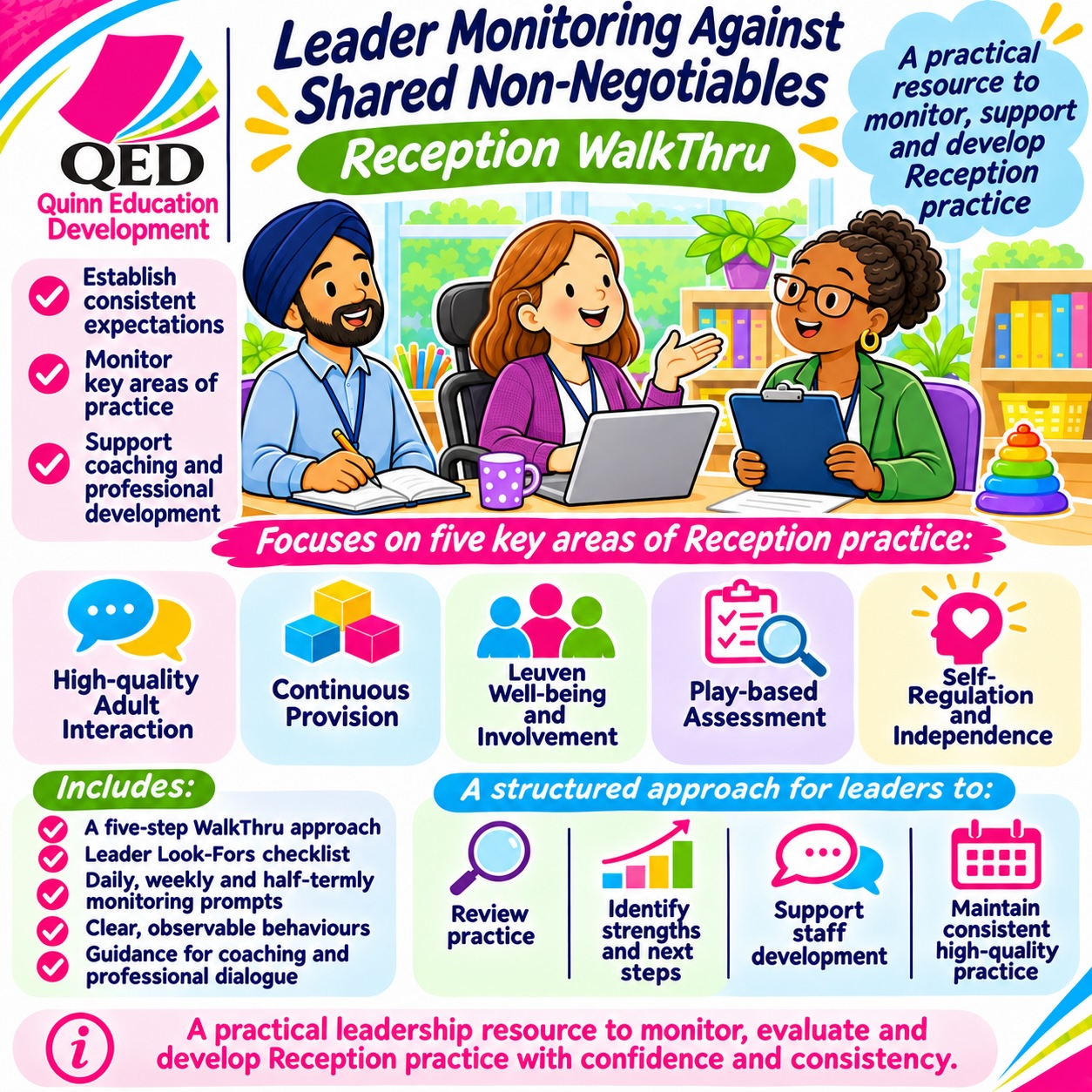
The Leader Monitoring Against Shared Non-Negotiables – Reception WalkThru is a practical leadership and monitoring resource designed to help Early Years leaders establish consistent expectations, review classroom practice and support professional development across Reception settings.
Focused on five key areas of Early Years practice – interaction, continuous provision, Leuven well-being and involvement, play-based assessment and self-regulation – this resource provides a structured framework for leaders to monitor how agreed approaches are being implemented and identify where further support or development may be needed.
Rather than relying on general observations, the WalkThru focuses on clear, observable behaviours that demonstrate effective practice. It helps leaders look beyond whether strategies are being used to consider how they are contributing to children’s independence, engagement, communication and learning.
Five key areas of shared practice
The resource provides practical monitoring guidance across five important areas:
1. High-quality adult interaction
Review how adults enter children’s play with purpose, use narrated learning, support and extend children’s thinking, introduce rich vocabulary and use agreed approaches to conflict resolution. The focus is on making interactions intentional and using them to deepen learning.
2. Continuous provision
Consider whether learning areas are calm, organised and purposeful. Monitor how new provision and equipment are introduced, whether children understand how to use and care for resources, and whether adults model expectations before encouraging independent use.
3. Leuven well-being and involvement
Review how staff recognise and respond to children’s levels of involvement. This includes responding promptly to low involvement, adapting the environment and adult deployment, and providing appropriate challenge for children demonstrating high involvement.
4. Play-based assessment
Monitor how adults use children’s play to assess vocabulary, communication, mathematical understanding, comprehension, well-being and play behaviours. Consider whether misconceptions and next steps are recorded daily and used to inform planning and provision.
5. Self-regulation and independence
Review how adults model plan–do–review, encourage children to stop, check and think, develop emotional vocabulary and use co-regulation. Consider whether predictable routines help children become increasingly independent and confident.
A practical approach to leadership monitoring
The resource encourages leaders to review practice at different intervals:
- Daily: Review involvement levels, record misconceptions and next steps, and reinforce routines and expectations.
- Weekly: Review Leuven actions, adjust provision and consider the impact of adult interactions and assessment.
- Half-termly: Review the learning environment, refresh provision and evaluate staff interaction quality through coaching and professional discussion.
A dedicated Leader Look-Fors checklist provides a convenient reference for monitoring the environment, adult interactions, Leuven involvement, assessment and self-regulation.
Who is this resource for?
This resource is suitable for Headteachers, Deputy Headteachers, EYFS Leaders, Reception Leaders and Early Years improvement leads who want to establish a consistent approach to monitoring and developing practice.
Use it to support learning walks, professional dialogue, coaching conversations, staff development and regular reviews of Reception provision.
By establishing clear expectations and focusing on observable practice, this QED resource helps leaders move beyond monitoring for compliance towards developing a consistent, purposeful and high-quality Early Years environment where children can become confident, independent and engaged learners.
Please note: This resource focuses on Reception practice and is intended to support leadership monitoring, coaching and professional development. It should be used alongside your school’s curriculum, policies and professional judgement.



Reviews
There are no reviews yet.