Make Reception learning walks more focused, purposeful and evidence-informed.
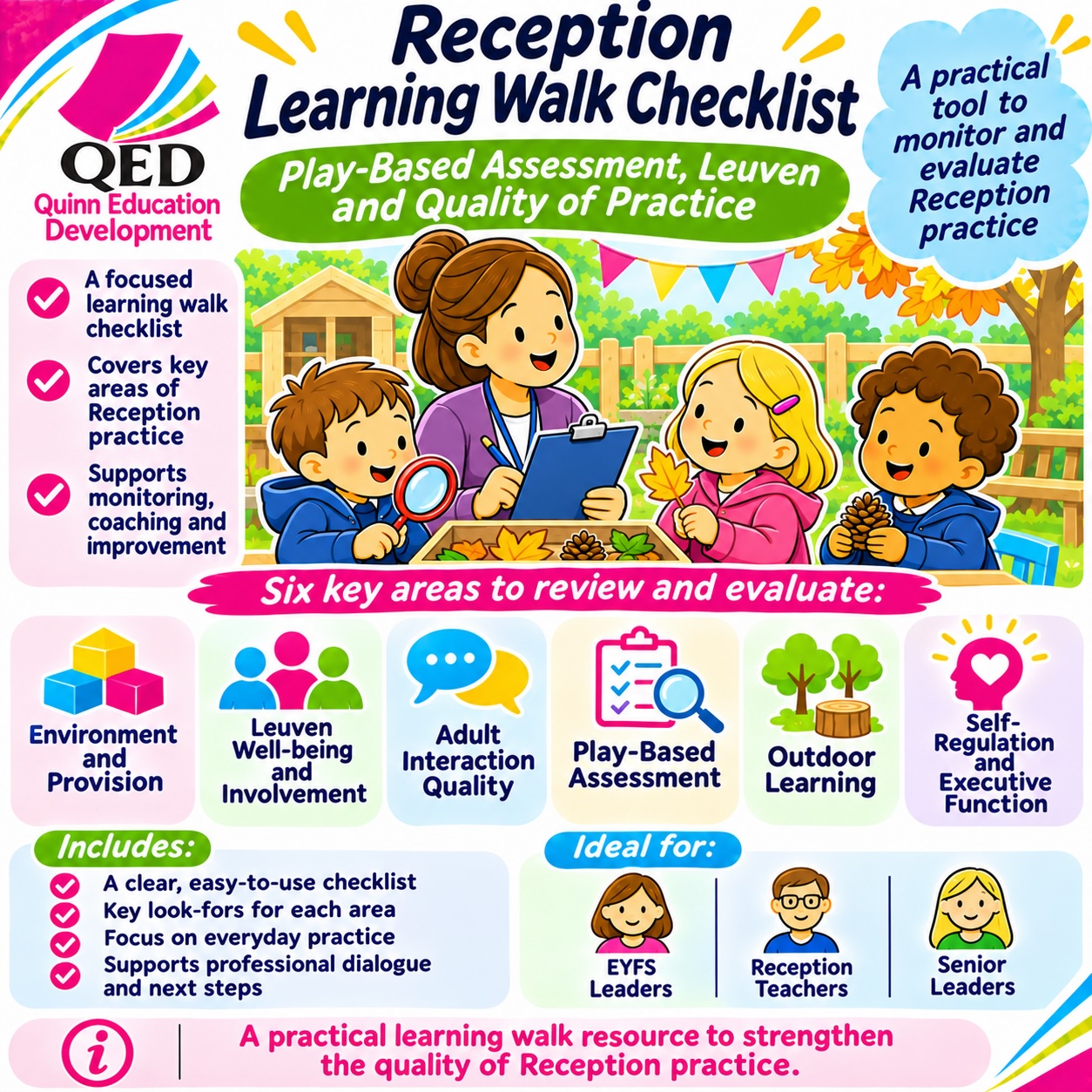
The Reception Learning Walk Checklist is a practical monitoring resource designed to help Early Years leaders evaluate the quality of teaching, interactions and provision within the Reception classroom.
Focusing on six key areas of effective Early Years practice, this checklist provides a clear framework for observing what is happening in the learning environment, how adults are supporting children’s development and how assessment is being used to inform teaching and provision.
Rather than relying on general observations, the checklist identifies specific features of effective practice that leaders can look for during learning walks. It helps ensure that monitoring focuses on children’s engagement, purposeful adult interaction and the quality of learning opportunities available throughout the day.
What does the checklist cover?
The resource is organised into six key areas:
1. Environment and Provision
Review the quality and organisation of indoor and outdoor learning environments. Consider whether provision areas are purposeful, resources are accessible and linked to curriculum intent, and routines are clearly established. The checklist also considers reduced clutter, sensory overload and whether outdoor learning is being used effectively.
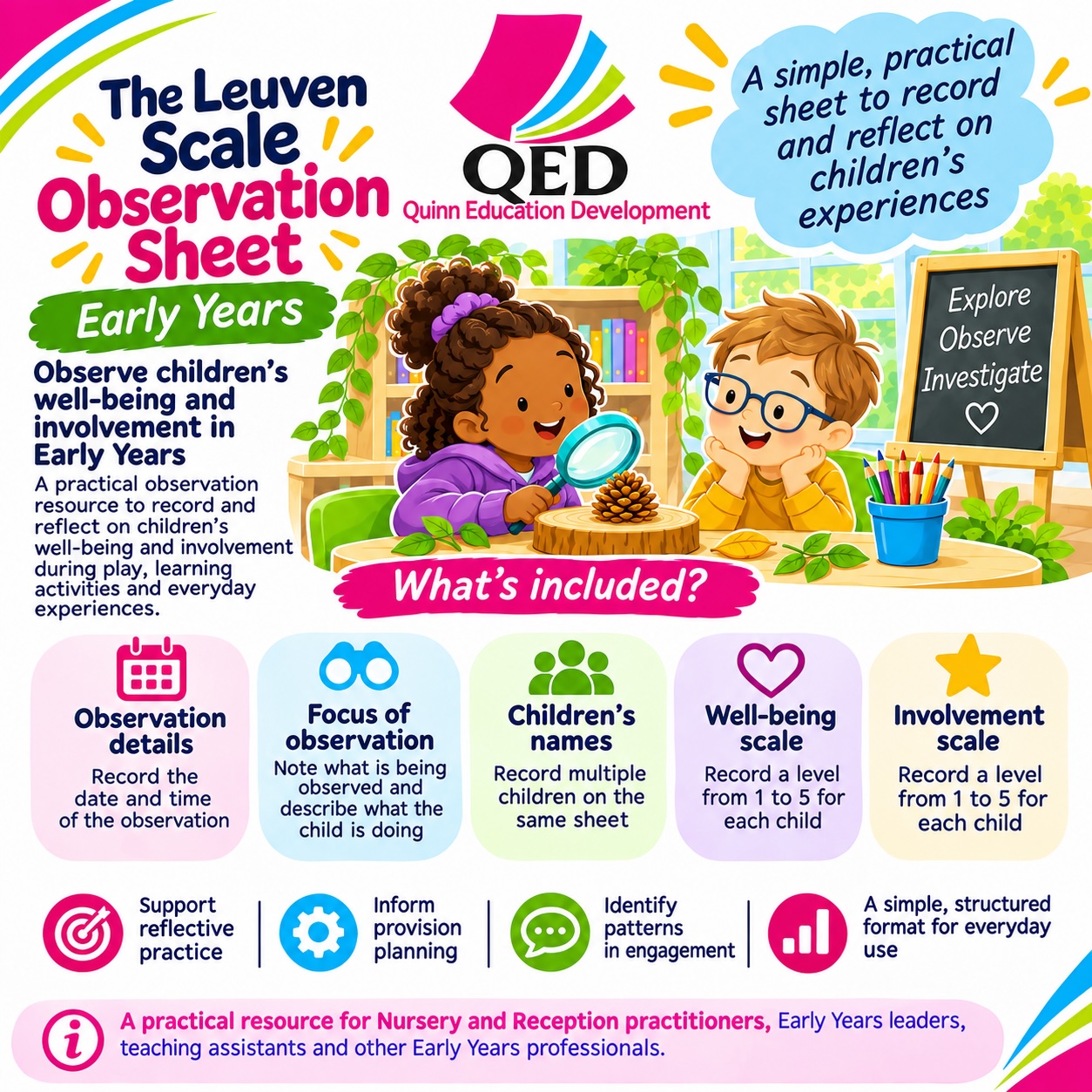
2. Leuven Well-being and Involvement
Evaluate how staff use Leuven observations to understand children’s experiences and engagement. Check whether practitioners know current scores for spotlight children, respond to low involvement levels (1–2) and provide appropriate challenge for children demonstrating high involvement (4–5). The checklist also considers how adjustments to resources, noise levels and adult interaction support children’s engagement.
3. Adult Interaction Quality
Observe how adults participate in children’s play and support learning through purposeful interactions. The checklist focuses on rich language modelling, recasting and extending vocabulary, sustained shared thinking, questioning, problem-solving and reasoning. It also considers how adults respond sensitively to children’s emotions and adapt their interactions according to children’s levels of involvement.
4. Play-Based Assessment
Review how practitioners use children’s play to assess understanding and identify next steps. This includes checking phonics, vocabulary, mathematical concepts, story structure, problem-solving and social and emotional skills. The checklist considers how targeted questioning, observations and Day Book notes are used to identify misconceptions and inform changes to provision and groupings.
5. Outdoor Learning
Evaluate whether outdoor learning is an integral part of the Reception day. Consider the quality of adult interactions, opportunities for literacy and mathematics, gross motor challenges and children’s engagement. The checklist also explores how outdoor equipment is introduced gradually, with appropriate routines and expectations.
6. Self-Regulation and Executive Function
Review how children are supported to develop independence, manage challenges and regulate their behaviour. The checklist includes plan–do–review routines, consistent conflict-resolution scripts, visual supports and adults modelling strategies such as stopping, checking and thinking.
A practical tool for Early Years leadership
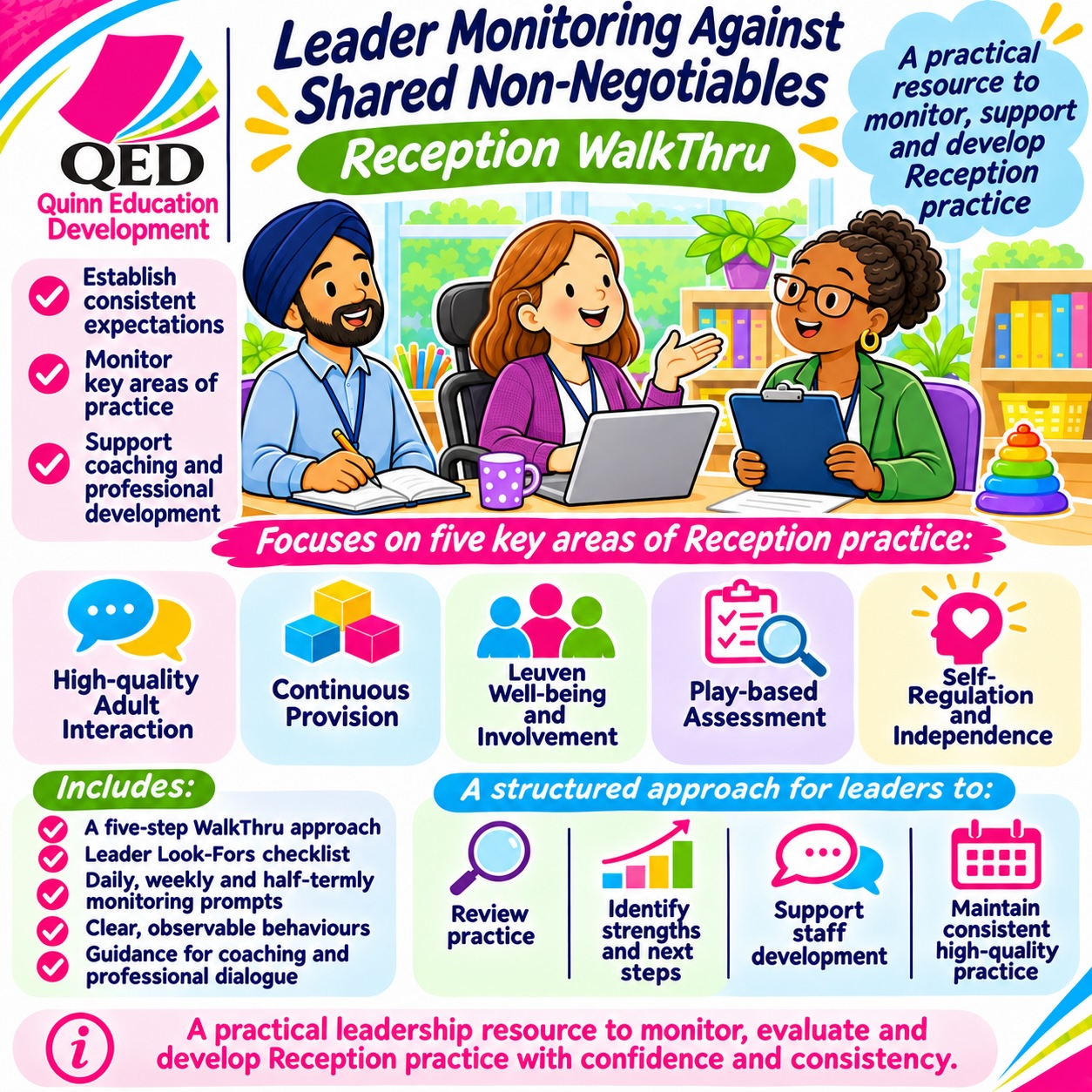
The checklist provides a straightforward structure for focused learning walks, helping leaders identify strengths, recognise inconsistencies and consider where further support or development may be needed.
It can be used to support professional conversations, staff coaching, leadership monitoring and reviews of Reception provision. By focusing on observable practice, it encourages leaders to look beyond the physical environment and consider the quality of children’s experiences and the impact of adult interactions.
Who is this resource for?
This resource is suitable for EYFS leaders, Reception teachers, deputy headteachers, headteachers, senior leadership teams and Early Years improvement partners.
Whether you are reviewing Reception provision, monitoring the implementation of play-based assessment or strengthening consistency in adult interactions, this checklist provides a practical reference to support focused observations and meaningful professional discussions.
A useful addition to your Early Years leadership toolkit, helping you keep children’s engagement, well-being and learning at the centre of Reception practice.


Reviews
There are no reviews yet.