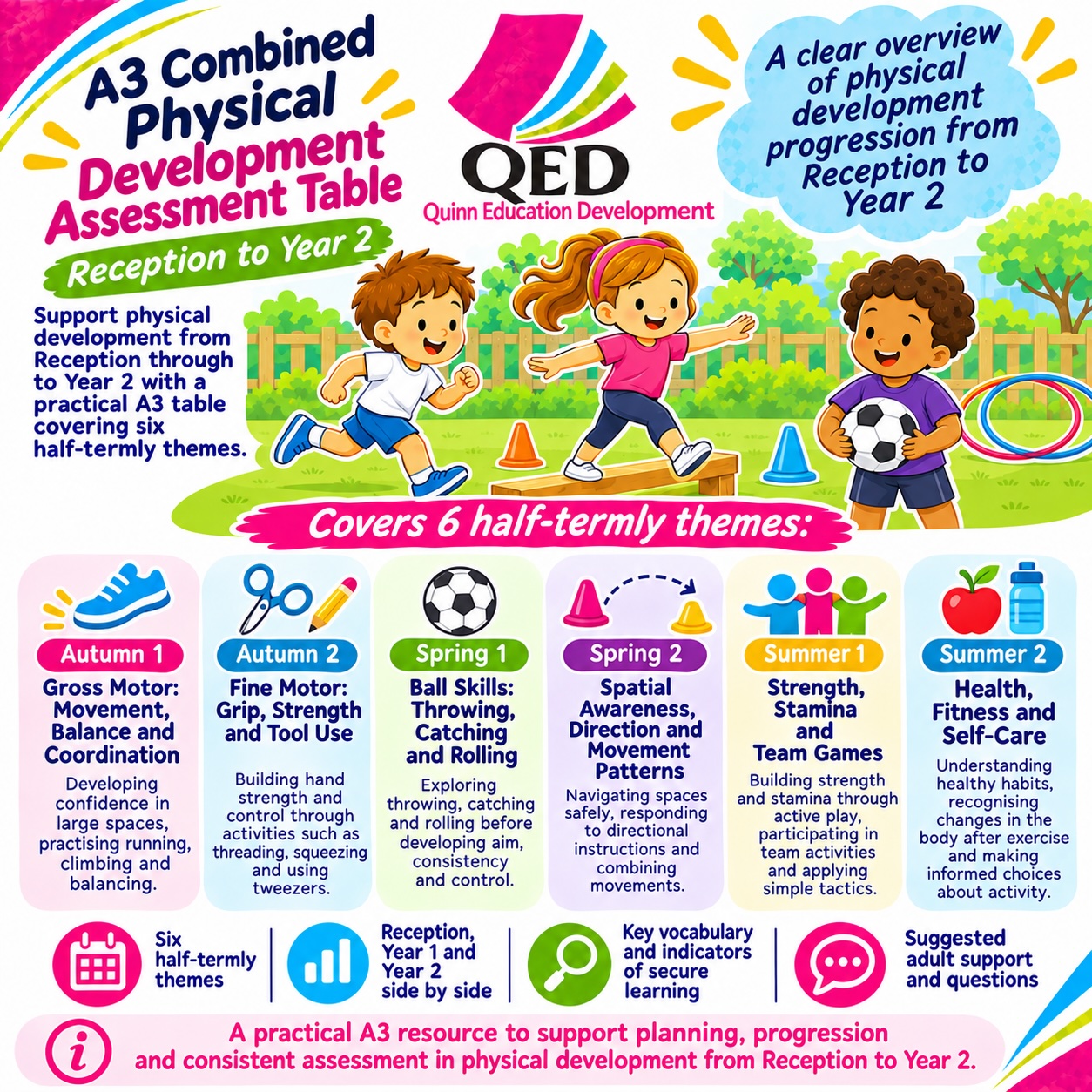
Support physical development from Reception through to Year 2 with this practical A3 Combined Physical Development Assessment Table. Designed to bring three year groups together in one clear overview, this resource maps key objectives across six half-termly themes, helping teachers plan activities, observe developing skills and identify appropriate next steps.
By aligning Reception, Year 1 and Year 2 within each half-term, the table makes it easier to see how children’s physical skills can develop over time. It covers gross-motor movement, fine-motor control, ball skills, spatial awareness, strength, stamina, team games, health and self-care.
The resource is organised around six half-termly themes:
Autumn 1 – Gross Motor: Movement, Balance and Coordination: developing confidence in large spaces, practising running, climbing and balancing, and progressing towards controlled movement sequences.
Autumn 2 – Fine Motor: Grip, Strength and Tool Use: building hand strength and control through activities such as threading, squeezing and using tweezers, before developing pencil grip and greater precision with tools.
Spring 1 – Ball Skills: Throwing, Catching and Rolling: exploring throwing, catching and rolling before developing aim, consistency and control through guided practice and target games.
Spring 2 – Spatial Awareness, Direction and Movement Patterns: navigating spaces safely, responding to directional instructions and combining movements with improved timing and coordination.
Summer 1 – Strength, Stamina and Team Games: building strength and stamina through active play, participating in team activities and beginning to apply simple tactics and strategies.
Summer 2 – Health, Fitness and Self-Care: understanding healthy habits, recognising changes in the body after exercise and making increasingly informed choices about physical activity.
Each half-termly section includes objectives, relevant vocabulary, indicators of secure learning, suggested adult support and questions to guide teaching. This gives staff practical ideas for supporting children’s development through structured activities, active play, modelling and adult interaction.
Suggested approaches include providing varied outdoor movement challenges, setting up fine-motor stations, using large balls for guided practice, creating obstacle courses, introducing movement games and modelling cooperation during team activities. Questions such as “How can you keep your body steady?”, “Where are you aiming?” and “What changed in your body after running?” can encourage children to reflect on their movements, develop their understanding and talk about their progress.
The table also highlights how physical development can be supported progressively across the three year groups. Children in Reception are encouraged to explore movements, build strength and develop control. In Year 1, the focus extends to coordination, safe tool use, responding to instructions and participating in team games. By Year 2, children are supported to refine their accuracy, combine movements, apply simple tactics and make choices that help develop fitness and stamina.
Designed for practical classroom use, the A3 format brings the progression overview together in one place. It can support medium-term planning, activity preparation, professional discussions, curriculum reviews and transition planning between Reception and Key Stage 1.
Whether you are a Reception teacher, KS1 class teacher, EYFS leader, PE lead or senior leader, this resource offers a useful starting point for organising physical development opportunities and discussing children’s developing skills across the early primary years.
Please note: The objectives and secure indicators are intended to support planning and professional observation. They should be used alongside your school’s curriculum, planned physical education provision and professional judgement, rather than as a standalone diagnostic tool or substitute for statutory assessment requirements.
The progression across the three year groups helps staff consider how early mathematical experiences can provide foundations for more complex learning. Reception focuses on practical exploration, early number, sorting, shape and patterns. Year 1 extends this into calculation, place value, measurement and grouping. Year 2 develops these ideas further through larger numbers, multiplication and division, fractions, time, money and problem solving.
Designed for practical classroom use, the A3 format brings the overview together in one place. It can support medium-term planning, curriculum reviews, professional discussions, assessment conversations and transition planning between Reception and Key Stage 1.
Whether you are a Reception teacher, KS1 class teacher, maths subject leader, EYFS leader or senior leader, this resource provides a clear starting point for reviewing maths progression and coordinating planning across year groups.
Please note: The objectives and secure indicators are intended to support planning and professional assessment judgements. Use the table alongside your school’s curriculum and chosen teaching sequence. Although the resource is aligned with White Rose Maths small steps, check the sequence against your current White Rose materials before using it as a definitive term-by-term curriculum map.
Reviews
There are no reviews yet.