Understand children’s well-being and involvement to improve learning
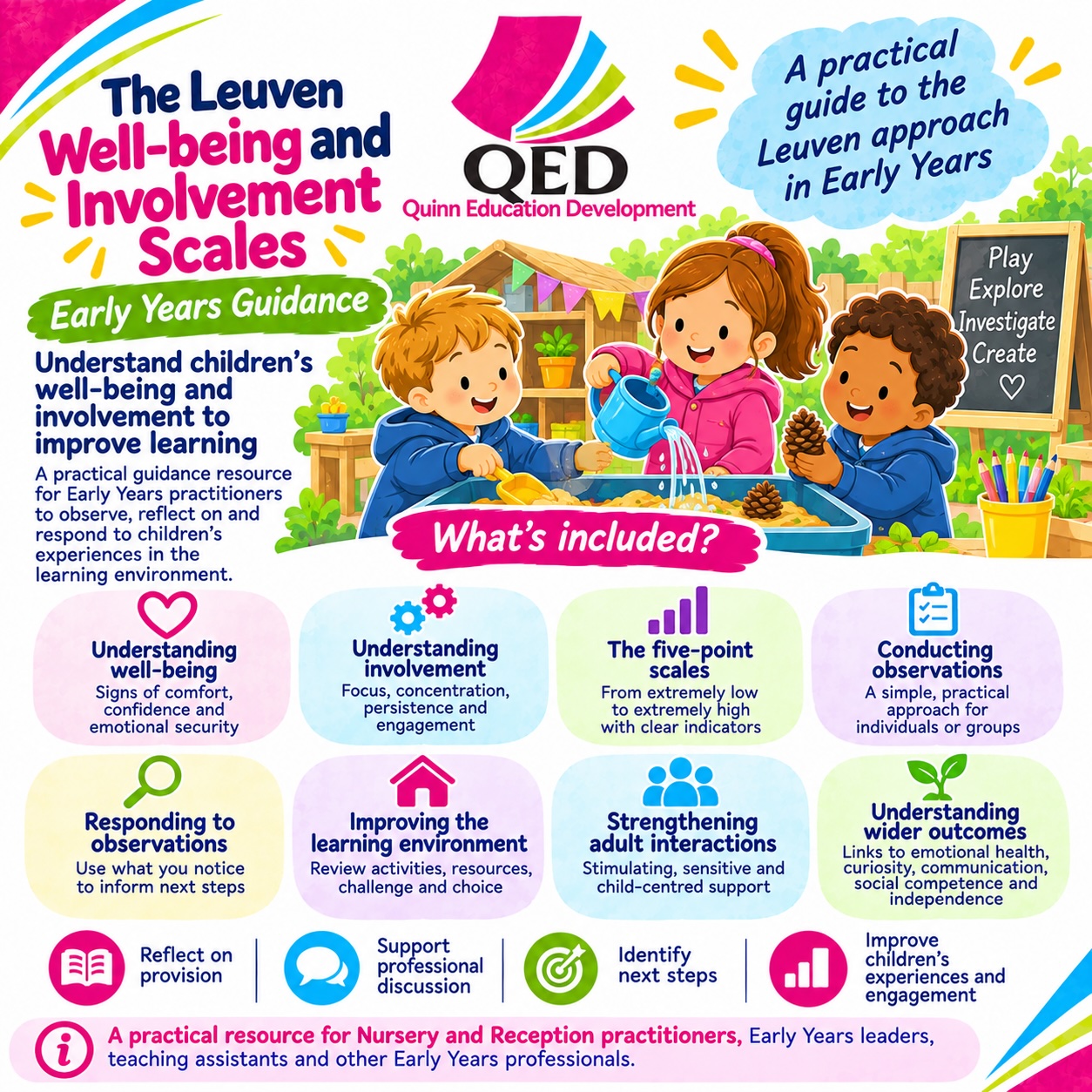
The Leuven Well-being and Involvement Scales is a guidance resource for Early Years practitioners who want to develop their understanding of children’s experiences and engagement within the learning environment.
The document introduces the Leuven approach to observing two important indicators of children’s experiences: well-being and involvement. Well-being relates to how comfortable, confident and emotionally secure a child appears, while involvement considers the extent to which a child is absorbed, focused and engaged in an activity.
These observations can help practitioners reflect on the quality of their provision, the suitability of activities and the effectiveness of adult interactions. Rather than looking only at what children achieve, the approach encourages practitioners to consider how children experience their learning and whether the environment supports meaningful engagement.
What do the Leuven well-being and involvement scales cover?
The guidance explores several key areas:
- Understanding well-being: Explore the signs practitioners may observe when children appear comfortable, confident and emotionally secure, as well as indicators that a child may be experiencing discomfort or tension.
- Understanding involvement: Consider how children’s concentration, persistence, energy and engagement can provide insight into their experiences of play and learning.
- The five-point scales: Learn about the levels used to describe well-being and involvement, ranging from extremely low to extremely high, with behavioural indicators to support observation.
- Conducting observations: Explore a simple approach to observing children individually or in groups for approximately two minutes before recording a level on the relevant scale.
- Responding to observations: Consider how lower levels of well-being or involvement can prompt further reflection on children’s needs, the learning environment and the support being offered.
- Improving the learning environment: Explore practical areas for review, including classroom organisation, the challenge offered by activities, the use of new materials, children’s interests and opportunities for independent exploration.
- Strengthening adult interactions: Reflect on how stimulating experiences, sensitive responses and opportunities for children to exercise autonomy can support engagement and development.
- Understanding wider outcomes: Consider the connections the document makes between well-being, involvement, emotional health, curiosity, communication, social competence and children’s developing independence.
The resource also includes further reading and a visual framework connecting the learning environment, the learning process and children’s developmental outcomes.
Turn observation into purposeful action
The Leuven approach encourages practitioners to use observations as a starting point for reflection rather than treating a rating as a judgement about a child. Patterns in well-being and involvement can help staff consider whether activities are sufficiently engaging, whether children have meaningful choices and whether additional support or changes to provision may be helpful.
The document highlights that children’s levels can fluctuate throughout the day. Observations should therefore be interpreted in context and alongside practitioners’ knowledge of individual children, rather than relying on a single score.
Practitioners can use the guidance to inform discussions about continuous provision, adult-child interactions, children’s interests and the overall quality of the learning environment.
Who is this resource for?
This resource is relevant to Nursery and Reception practitioners, Early Years leaders, teaching assistants and professionals involved in observing children’s learning and development.
It can support professional development, reflective discussions, provision reviews and the development of observation practices within an Early Years setting.
A useful reference for reflective Early Years practice, the document introduces a structured way to consider children’s well-being and involvement and use observations to inform decisions about learning experiences and provision.

Reviews
There are no reviews yet.