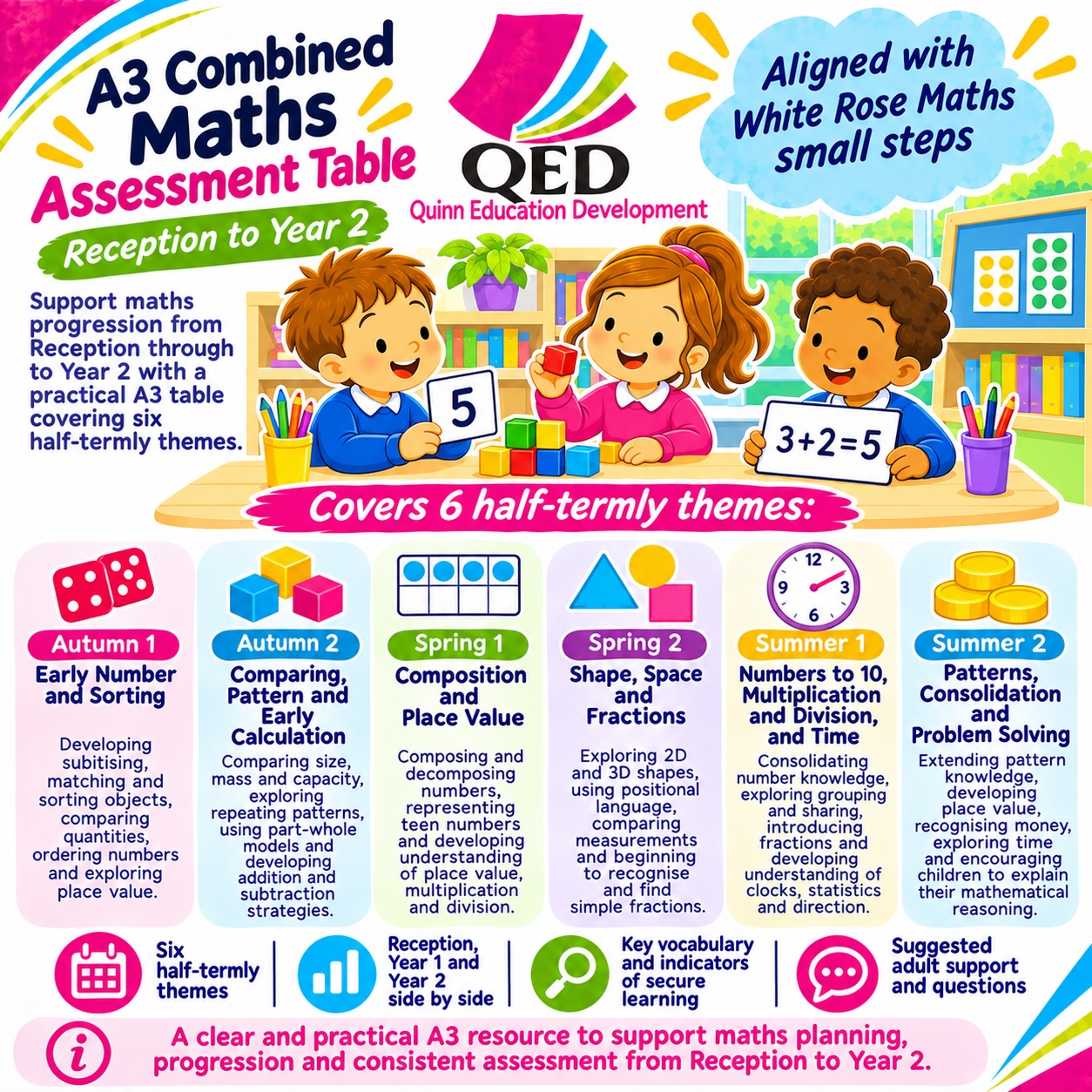
Support maths progression from Reception through to Year 2 with this practical A3 Combined Maths Assessment Table. Aligned with White Rose Maths small steps, this resource brings together objectives for all three year groups across six half-termly themes, helping teachers plan learning, assess developing understanding and identify appropriate next steps.
Designed to make progression easier to see, the combined table places Reception, Year 1 and Year 2 objectives side by side. Teachers can use it to review how mathematical knowledge and skills develop, support continuity between the Early Years Foundation Stage and Key Stage 1, and inform discussions about curriculum coverage and assessment.
The table covers six half-termly themes:
Autumn 1 – Early Number and Sorting: developing subitising, matching and sorting objects, comparing quantities, ordering numbers and exploring place value.
Autumn 2 – Comparing, Pattern and Early Calculation: comparing size, mass and capacity, exploring repeating patterns, using part-whole models and developing addition and subtraction strategies.
Spring 1 – Composition and Place Value: composing and decomposing numbers, representing teen numbers and developing understanding of place value, multiplication and division.
Spring 2 – Shape, Space and Fractions: exploring 2D and 3D shapes, using positional language, comparing measurements and beginning to recognise and find simple fractions.
Summer 1 – Numbers to 10, Multiplication and Division, and Time: consolidating number knowledge, exploring grouping and sharing, introducing fractions, and developing understanding of clocks, statistics and direction.
Summer 2 – Patterns, Consolidation and Problem Solving: extending pattern knowledge, developing place value, recognising money, exploring time and encouraging children to explain their mathematical reasoning.
Each half-termly section includes learning objectives, relevant mathematical vocabulary, indicators of secure learning, suggested adult support and questions to guide teaching. This makes the table a useful reference when preparing activities, selecting practical resources and considering how to support children’s mathematical understanding.
Suggested approaches include using manipulatives to compare quantities, number lines and ten frames to support calculation, Base-10 equipment to develop place-value understanding, shape hunts to explore geometry, practical measuring activities and arrays to introduce equal groups. Questions such as “Can you show 5 in another way?”, “Are the parts equal?” and “How do you know your answer is correct?” encourage children to explain their thinking as well as demonstrate what they know.
The progression across the three year groups helps staff consider how early mathematical experiences can provide foundations for more complex learning. Reception focuses on practical exploration, early number, sorting, shape and patterns. Year 1 extends this into calculation, place value, measurement and grouping. Year 2 develops these ideas further through larger numbers, multiplication and division, fractions, time, money and problem solving.
Designed for practical classroom use, the A3 format brings the overview together in one place. It can support medium-term planning, curriculum reviews, professional discussions, assessment conversations and transition planning between Reception and Key Stage 1.
Whether you are a Reception teacher, KS1 class teacher, maths subject leader, EYFS leader or senior leader, this resource provides a clear starting point for reviewing maths progression and coordinating planning across year groups.
Please note: The objectives and secure indicators are intended to support planning and professional assessment judgements. Use the table alongside your school’s curriculum and chosen teaching sequence. Although the resource is aligned with White Rose Maths small steps, check the sequence against your current White Rose materials before using it as a definitive term-by-term curriculum map.


Reviews
There are no reviews yet.